


CausalCompass
CausalCompass is a Python package that provides a flexible and extensible benchmark suite for evaluating the robustness of time-series causal discovery (TSCD) methods under misspecified modeling assumptions. Online documentation for this anonymous copy is available at Documentation.
Abstract
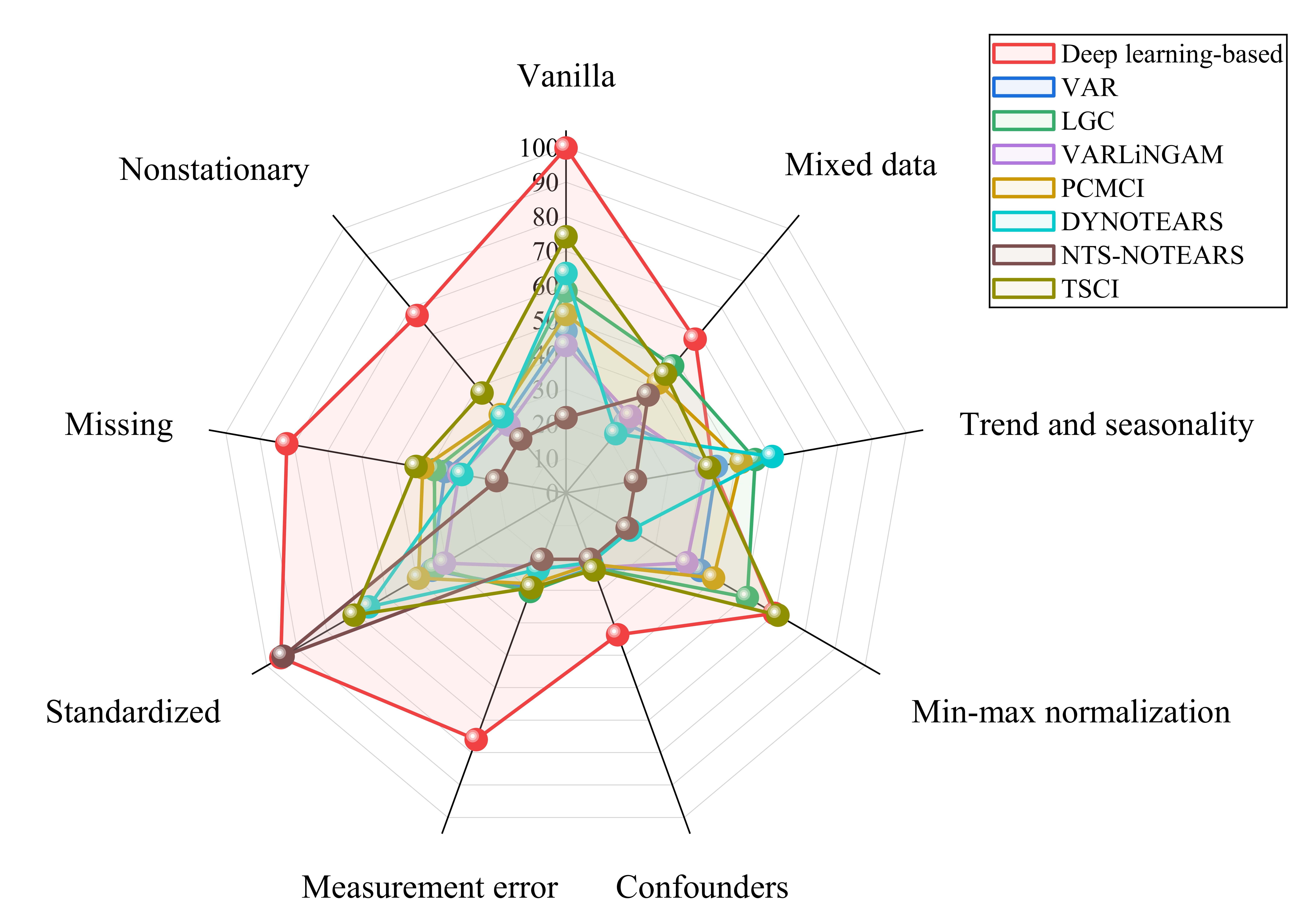
Causal discovery from time series is a fundamental task in machine learning. However, its widespread adoption is hindered by a reliance on untestable causal assumptions and by the lack of robustness-oriented evaluation in existing benchmarks. To address these challenges, we propose CausalCompass, a flexible and extensible benchmark suite designed to assess the robustness of time-series causal discovery (TSCD) methods under violations of modeling assumptions. To demonstrate the practical utility of CausalCompass, we conduct extensive benchmarking of representative TSCD algorithms across eight assumption-violation scenarios. Our experimental results indicate that no single method consistently attains optimal performance across all settings. Nevertheless, the methods exhibiting superior overall performance across diverse scenarios are almost invariably deep learning-based approaches. We further provide hyperparameter sensitivity analyses to deepen the understanding of these findings. We also find, somewhat surprisingly, that NTS-NOTEARS relies heavily on standardized preprocessing in practice, performing poorly in the vanilla setting but exhibiting strong performance after standardization. Finally, our work aims to provide a comprehensive and systematic evaluation of TSCD methods under assumption violations, thereby facilitating their broader adoption in real-world applications.
Key Features
8 assumption-violation scenarios: Confounders, nonstationarity, measurement error, standardization, missing data, mixed data, min-max normalization, and trend/seasonality
2 vanilla models: VAR (linear) and Lorenz-96 (nonlinear)
11 TSCD algorithms spanning 6 major methodological categories:
Granger causality-based: VAR, LGC
Constraint-based: PCMCI
Noise-based: VARLiNGAM
Score-based: DYNOTEARS, NTS-NOTEARS
Topology-based: TSCI
Deep learning-based: cMLP, cLSTM, CUTS, CUTS+
Datasets
The datasets/ directory contains sample datasets. Complete datasets can be generated using the provided scripts. For convenience and reproducibility, the complete datasets archive is publicly available at
Kaggle.
The generated datasets follow the naming convention:
[scenario]_[params]_[model]_p[p]_T[T]_[optional]_seed[seed].npz
Example: confounder_rho0.5_VAR_p10_T1000_seed0.npz
Citation
If you use this code or datasets in your research, please cite:
@misc{yi2026causalcompass,
  title   = {{CausalCompass}: Evaluating the Robustness of Time-Series Causal Discovery in Misspecified Scenarios},
  author  = {Anonymous Authors},
  year    = {2026},
  note    = {Under review as a conference paper}
}
License
The code in this repository is released under the MIT License; see
LICENSEin the repository root.The datasets generated and provided by this repository are released under the CC BY 4.0 License; see
LICENSE-CC-BY-4.0in the repository root.
Contributing
Contributions are welcome! If you encounter bugs, have suggestions for improvements, or would like to extend CausalCompass with additional assumption-violation scenarios or evaluation protocols, please feel free to open an issue or submit a pull request.
Contact
For questions or issues, please:
Open an issue in this repository
Contact details are intentionally omitted for anonymous review.